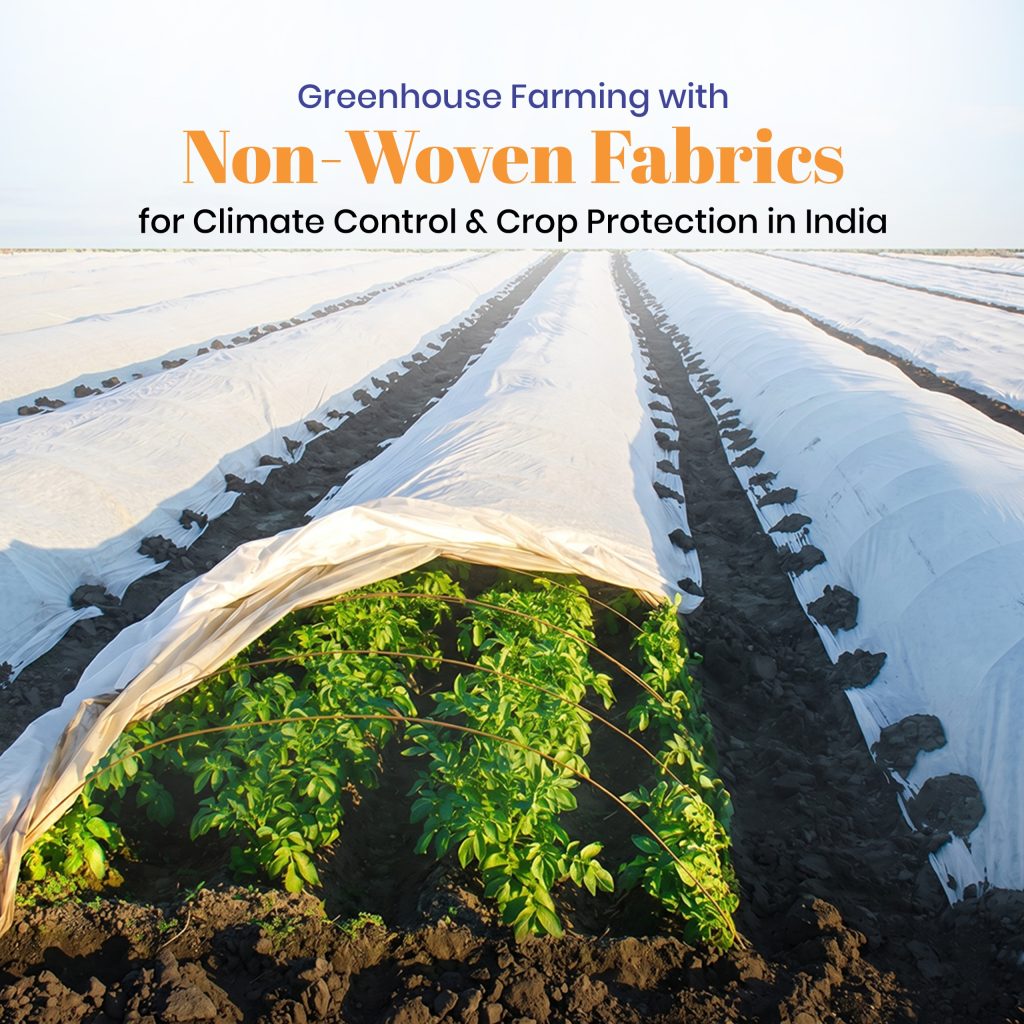
Greenhouse farming with non-woven fabrics is steadily becoming the most reliable crop protection strategy for Indian farmers dealing with unpredictable weather, pest pressure, and extreme seasonal temperatures. Every year, Indian farmers lose thousands of crores in crop value due to frost, hailstorms, scorching heat, and insect infestations. However, non-woven fabric for greenhouse farming offers a single, practical, and affordable solution to all these challenges simultaneously. Farmers across Maharashtra, Telangana, Punjab, Karnataka, and Gujarat are already using non-woven agriculture fabric to protect their crops, improve produce quality, and harvest consistently throughout the year. Moreover, farmers who adopt protective crop covers for greenhouse farming report yield improvements of 30% to 40% per growing season. This guide covers everything — temperature management, shading, GSM selection, and year-round greenhouse crop protection India strategies.
Why Non-Woven Fabric for Greenhouse Farming Is Growing Across India
Greenhouse farming in India has expanded rapidly over the past decade. However, most farmers still rely on outdated covering materials that either trap excessive heat or fail to protect crops from insects and frost. Fortunately, agricultural non-woven fabric solves all these problems with one versatile, easy-to-use product.
PP spunbond non-woven agriculture fabric is manufactured from fine polypropylene filaments that are thermally bonded together — without weaving or knitting. This process creates a breathable, lightweight, and durable fabric that performs consistently across all growing seasons. Unlike plastic film that dangerously traps heat underneath, non-woven fabric for greenhouse applications allows air and moisture vapour to pass through freely. As a result, crops covered with it stay healthier, grow more evenly, and face significantly fewer fungal disease problems.
Furthermore, crop protection fabric for farming is available across a wide range of GSM grades — from 17 GSM to 80 GSM — making it suitable for almost every crop type and climate zone across India. Therefore, whether you grow vegetables in Telangana or exotic flowers in Pune, non-woven agriculture fabric has the right grade for your exact farming need.
Key Advantages of Agricultural Non-Woven Fabric for Indian Farmers
- Breathable structure prevents dangerous heat build-up and fungal disease spread
- Uniform light diffusion actively promotes consistent, even plant growth across the canopy
- Physical pest barrier effectively reduces chemical pesticide dependency on the farm
- Lightweight design allows direct placement over crops without any support structures
- UV-stabilised grades last two to four growing seasons with proper care and storage
- Fully compatible with certified organic farming contains zero harmful chemical additives
Temperature Control in Greenhouse Farming with Non-Woven Fabrics
The most compelling reason farmers choose greenhouse farming with non-woven fabrics is its outstanding ability to manage temperature. Greenhouse temperature management is a critical challenge across India — crops face intense summer heat and damaging winter frost within the same calendar year. Non-woven agriculture fabric addresses both extremes practically and affordably.
How Non-Woven Fabric Solves Summer Heat in Indian Greenhouses
During Indian summers, field temperatures regularly exceed 40°C across Maharashtra, Rajasthan, and Gujarat. These extreme conditions severely stress cool-season crops like lettuce, spinach, and cauliflower. However, a 30–45 GSM greenhouse shading fabric used as an overhead cover reflects a significant portion of incoming solar radiation. Consequently, the growing environment beneath stays 4°C to 8°C cooler than uncovered areas nearby.
This temperature reduction is sufficient to extend the growing season of cool-weather vegetables well beyond their normal limits. Furthermore, because greenhouse shade cloth India diffuses sunlight rather than blocking it entirely, crops still receive the productive light they need to grow well. Therefore, farmers achieve both effective temperature control and consistent yield — without sacrificing one for the other.
Additionally, uniform light diffusion from non-woven fabric for greenhouse covers prevents damaging hot spots that commonly form under HDPE shade nets. This ensures every plant in the growing row develops evenly — which directly improves marketable produce quality and farm profitability.
How Non-Woven Crop Covers Prevent Winter Frost Damage
Winter frost remains a serious risk for farmers across northern and central India. States like Uttar Pradesh, Punjab, and Madhya Pradesh experience overnight temperatures below 5°C from December to February. A single frost event destroys months of careful crop growth within just a few hours.
A 17–25 GSM protective crop cover for greenhouse placed over crops before nightfall traps warmth radiating from soil and plant surfaces efficiently. As a result, the temperature under the cover stays 2°C to 5°C warmer than the open field outside. This consistent buffer protects tomatoes, capsicum, brinjal, and marigold from frost damage every night throughout the season. Moreover, the fabric is light enough to rest directly on leaves without causing any physical damage making installation simple, fast, and highly cost-effective for farmers at every scale.
Greenhouse Shading Fabric: Choosing the Right GSM for Every Crop
Selecting the correct GSM of greenhouse shading fabric is the most important technical decision in greenhouse farming with non-woven fabrics. The GSM rating determines light transmission, shading percentage, and insulation capacity of the fabric. Therefore, choosing correctly directly and significantly affects crop health, growth consistency, and final yield quality.
Year-Round Greenhouse Crop Protection India Farmers Can Rely On
Greenhouse crop protection India farmers need goes far beyond temperature management alone. Non-woven fabric for greenhouse applications delivers comprehensive protection against pests, hail, wind, and excessive soil moisture loss throughout every growing season consistently.
Pest Exclusion, Hail Protection, and Water Conservation
Non-woven agriculture fabric physically blocks small insects including aphids, whiteflies, and thrips from reaching plant surfaces and causing direct damage. These insects carry serious viral diseases such as yellow mosaic virus and tomato leaf curl virus that devastate entire crops. By preventing insect contact entirely, crop protection fabric for farming stops disease before it ever reaches the crop. Consequently, farmers reduce pesticide applications by two to three sprays per cycle lowering costs and improving produce safety simultaneously.
Additionally, protective crop covers for greenhouse overhead use protect delicate fruits and flowers from costly hailstorm damage every season. Grape growers in Nashik, pomegranate farmers in Solapur, and flower cultivators in Pune widely use overhead greenhouse shading fabric to prevent costly hail bruising on high-value export crops. Moreover, in arid regions like Rajasthan and Gujarat, agricultural non-woven fabric windbreaks reduce wind velocity by up to 50% protecting young plants from sandstorms and high-speed wind events effectively.
Furthermore, when used as ground mulch, non-woven agriculture fabric reduces soil water evaporation by 20–30% per season. This water-saving benefit delivers meaningful cost reductions for farmers in regions facing serious groundwater depletion — and directly supports national water conservation goals across India.
Blue Horse Non-Woven Fabric for Greenhouse Farming: Made in Hyderabad
Savitridevi Polyfabrics (India) Pvt. Ltd. manufactures premium PP spunbond non-woven fabric for greenhouse farming under the trusted Blue Horse brand from its facility in Hyderabad, Telangana. Every roll delivers consistent GSM, uniform width, and reliable UV stabilisation ensuring dependable performance season after season across all Indian farming regions.
The Blue Horse agricultural non-woven fabric range covers 10 GSM to 150 GSM, with custom roll widths up to 3.2 metres. Available in white, black, and green, with both hydrophilic and hydrophobic treatment options to match every farming requirement. Farmers, greenhouse builders, nurseries, and agri-distributors across India trust Blue Horse non-woven agriculture fabric for its outstanding quality, production consistency, and competitive bulk pricing throughout the year.
Visit savitripolyfab.com today to request samples, get bulk pricing, or speak directly with our team about the right greenhouse shading fabric grade for your specific crop and regional climate conditions.
Conclusion
Greenhouse farming with non-woven fabrics gives every Indian farmer a powerful, practical, and proven tool to protect crops across all four seasons effectively. From greenhouse temperature management and greenhouse crop protection India strategies to shading, pest exclusion, and water conservation non-woven fabric for greenhouse farming delivers consistent, measurable results throughout the entire crop calendar. Furthermore, its availability across GSM grades means every crop from vegetables and flowers to spices and fruits has a perfectly matched non-woven agriculture fabric solution ready for use.
Farmers who invest in quality PP spunbond non-woven fabric today will grow cleaner crops, achieve stronger yields, and build genuinely weather-resilient farming operations for every season ahead. Make the right decision for your farm choose Blue Horse non-woven fabric by Savitridevi Polyfabrics today.
Frequently Asked Questions
Q1. What is non-woven fabric for greenhouse farming?
Non-woven fabric for greenhouse farming is a lightweight, breathable PP spunbond material that controls temperature, provides shading, and protects crops from frost, pests, and hail across all seasons.
Q2. Which GSM of greenhouse shading fabric is best for vegetables?
A 17–30 GSM non-woven agriculture fabric is ideal for most vegetable crops like tomato, capsicum, and brinjal grown across India.
Q3. How does non-woven fabric help with temperature control in greenhouse farming?
Temperature control in greenhouse farming is achieved by using 30–45 GSM greenhouse shading fabric that keeps the growing environment 4°C to 8°C cooler in summer and 2°C to 5°C warmer at night in winter.
Q4. Is agricultural non-woven fabric safe for organic farming?
Yes, agricultural non-woven fabric contains no pesticides or harmful additives and is fully compatible with certified organic farming requirements across India.
Q5. Where can I buy Blue Horse non-woven fabric for greenhouse crop protection in India?
You can purchase Blue Horse crop protection fabric directly from Savitridevi Polyfabrics (India) Pvt. Ltd. — visit savitripolyfab.com for samples, bulk pricing, and expert guidance.