
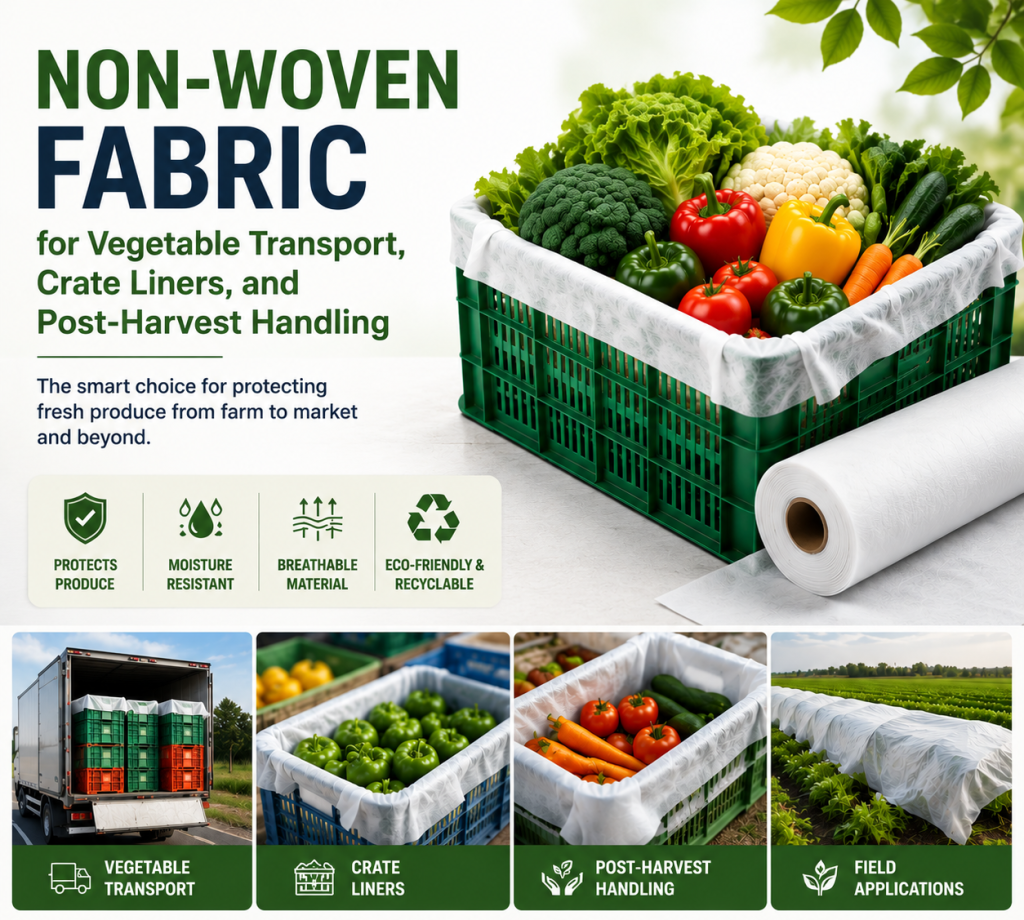
Non-woven fabric for vegetable transport is transforming the way fresh produce moves from farm to market across India. Farmers, distributors, and supply chain managers are steadily choosing PP spunbond solutions to protect vegetables during transit, reduce damage, and extend shelf life. Unlike conventional packaging materials, vegetable transport fabric combines breathability with structural strength, making it an ideal choice for India’s modern agricultural supply chain.
India loses an estimated 30–40% of its horticultural produce each year, according to the Indian Council of Agricultural Research. A significant portion of that loss happens during transport and storage, where heat buildup, moisture retention, and physical abrasion damage fresh vegetables. Addressing these challenges requires breathable packaging material that cushions, ventilates, and protects at every stage — and that is precisely what PP spunbond agricultural non-woven fabric delivers.
Why Vegetable Transport Fabric Outperforms Traditional Crate Liners
Conventional crate liners — whether plastic sheets, newspaper, or rough jute — fall short in several important ways. Plastic traps heat and moisture, accelerating spoilage in enclosed crates. Newspaper is inconsistent in quality and can leave residues on produce surfaces. Jute, while breathable, is coarse and abrasive against tender vegetable skins during long-distance transport.
Crate liner fabric made from PP spunbond offers a measurably better alternative across all these dimensions. The polypropylene spunbond structure creates millions of tiny interconnected pores that allow air to circulate freely around the produce. This natural breathability helps regulate temperature inside crates, especially during long-haul road transport under India’s intense summer sun.
Selecting the Right GSM for Agricultural Non-Woven Fabric
Choosing the correct GSM — grams per square metre — is essential when using non-woven fabric as a crate liner or transport wrap. GSM determines thickness, softness, and structural strength, and matching it to the produce type makes a clear operational difference.
For delicate vegetables such as tomatoes, capsicums, and leafy greens, a lower GSM range of 15 to 25 grams provides a gentle cushioning layer without adding unnecessary bulk. This weight allows good air circulation and makes handling smooth at packing stations. For sturdier produce like onions, potatoes, and raw gourds that require more padding during transit, a medium GSM between 30 and 50 delivers improved abrasion resistance while maintaining the breathability that defines quality vegetable protection fabric.
Crop Protection Fabric: Preserving Freshness at Every Post-Harvest Stage
The vegetable supply chain does not end at the farm gate. Post-harvest handling involves cleaning, grading, packing, cold storage, and final distribution — and at each of these stages, produce is exposed to handling stress. Crop protection fabric plays a valuable role throughout this entire journey, from packing house to retail shelf.
In packing houses and aggregation centres, non-woven sheets are placed between vegetable layers inside crates to prevent friction damage during consolidation. In cold storage facilities, breathable packaging material allows cold air to circulate evenly over the produce while protecting surfaces from condensation drip. During final distribution to markets and retail stores, lightweight vegetable packaging fabric maintains individual produce presentation and reduces contact bruising across the last mile.
This consistency is critical for operations where fabric is cut, folded, and reused across multiple packing cycles throughout the season.
Heavy Duty Crate Liners That Reduce Post-Harvest Losses Across India
India’s vegetable supply chain spans enormous distances. Tomatoes travel from Nashik to Delhi. Onions move from Lasalgaon to Kolkata. Therefore, a good liner must absorb vibration, manage moisture, and allow steady air movement simultaneously.
PP spunbond heavy duty crate liners meet all three requirements effectively. The bonded fibre structure absorbs vibration energy during road transport, reducing bruising from constant movement on uneven roads. The open pore architecture allows excess moisture from produce respiration to escape rather than pool at the base of the crate. Unlike plastic liners, non-woven fabric does not create condensation buildup that can cause fungal growth on the undersides of crates and on the lowest vegetable layers.
Food Grade Non-Woven Fabric: Meeting India’s Food Safety Standards
Food safety in the vegetable supply chain is receiving increasing regulatory attention across India. The Food Safety and Standards Authority of India (FSSAI) has encouraged the use of food-grade, non-contaminating materials in produce handling and packaging. Food grade non-woven fabric made from virgin polypropylene is chemically inert, free from harmful additives, and does not react with vegetables even under warm and humid transit conditions.
Sustainable Agriculture Packaging for a Responsible Supply Chain
Beyond performance, today’s agricultural supply chain stakeholders are increasingly mindful of the environmental footprint of their packaging choices.
PP spunbond non-woven fabric scores well across all three of these criteria. Its reusability across multiple transport cycles reduces per-trip material consumption significantly compared to single-use plastic liners. Its light weight adds negligible load to transport vehicles, contributing to lower fuel usage per consignment.
Non-Woven Fabric for Vegetable Transport from Blue Horse®: Built for Indian Conditions
India’s diverse agricultural regions present unique operational challenges. Transport routes range from smooth national highways to rough rural approach roads. Temperatures span from humid coastal conditions to dry inland heat. Monsoon seasons introduce additional moisture management challenges. Consequently, agricultural non-woven fabric designed for Indian conditions must perform reliably across all these variables without losing structural integrity.
Custom widths and roll lengths are available to match specific crate dimensions and production line requirements.
Conclusion: The Right Fabric Makes the Difference at Every Mile
Fresh vegetables are among the most time-sensitive commodities in any supply chain. Every point of contact — the crate wall, the transport floor, the cold room shelf — carries the potential to damage produce that took an entire growing season to cultivate.
📞 Ready to Protect Your Produce with Blue Horse® Non-Woven Fabric?
Whether you are managing vegetable logistics for a farmer collective, running a packing house, or supplying fresh produce to retail chains, Blue Horse® has the right vegetable packaging fabric solution for your operation.
Get in touch with our team today:
- 📞 Call us: +91 99634 70257 / +91 99634 70259
- 📧 Email: info@savitripolyfab.com
- 🌐 Website: www.savitripolyfab.com
- 💬 WhatsApp: Chat with us now
FAQs
1. What is non-woven fabric used for in vegetable transport?
Non-woven fabric is used as crate liners and wrapping sheets to protect vegetables from bruising, moisture, and heat during road transport across India.
2. Which GSM is best for vegetable crate liners?
15–25 GSM suits delicate vegetables like tomatoes. 30–50 GSM works best for onions and potatoes. 60+ GSM is ideal for heavy-duty bundling and stacking.
3. Is Blue Horse® non-woven fabric food safe?
Yes. Blue Horse® PP spunbond fabric is made from virgin polypropylene, manufactured under GMP standards, and is completely safe for direct contact with fresh vegetables.
4. Can non-woven crate liners be reused?
Yes. Medium to heavy GSM grades (40–80) can be reused across multiple transport cycles when stored and handled with basic care at packing stations.
5. Does Blue Horse® offer custom widths for crate liner fabric?
Yes. Custom widths up to 128 inches and custom roll lengths are available to match any crate size or packing line requirement.