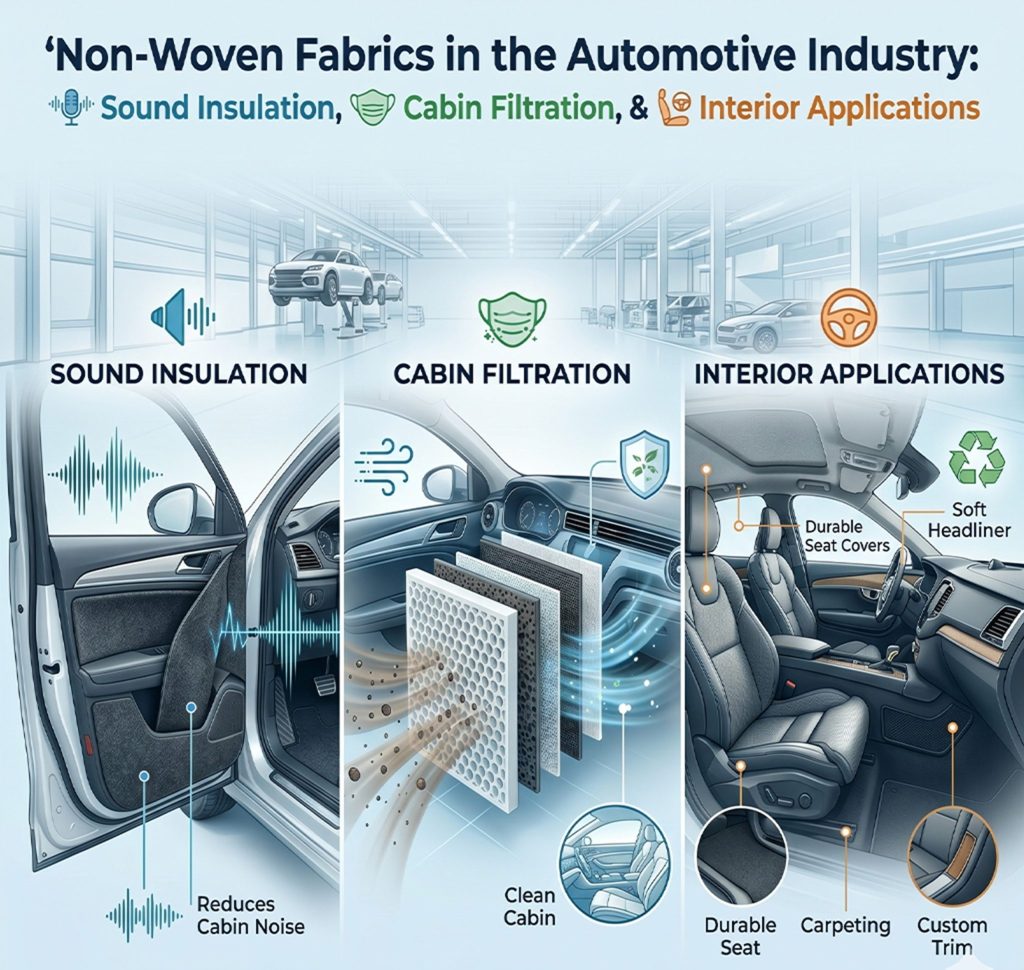
Non-woven fabrics in the automotive industry are quietly transforming the way modern vehicles are designed, built, and experienced and most drivers never even realise it. Every time you step into a car that feels refined, quiet, and well-finished, automotive non-woven fabric is working behind the scenes to deliver that comfort. However, beyond just the feel of the cabin, these materials play a critical engineering role across more than 40 functional parts inside every vehicle. Therefore, if you are a component manufacturer, automotive supplier, or procurement professional, understanding how non-woven fabric for car interiors, sound insulation, and filtration works will help you make smarter sourcing decisions.
India’s automotive industry is growing rapidly, and so is the demand for high-performance PP spunbond non-woven fabric from trusted Non Woven Fabric Manufacturers in Hyderabad. Furthermore, as manufacturers shift toward lighter, more fuel-efficient, and more sustainable vehicles, spunbond non-woven fabric for automobiles has become a material that no serious automaker can afford to overlook.
Why the Automotive Industry Relies on Non-Woven Fabric
The shift toward automotive non-woven fabric did not happen overnight. For decades, traditional woven textiles, foam, and rubber dominated vehicle interiors. However, as automakers faced growing pressure to reduce vehicle weight, improve passenger comfort, and meet stricter emission targets, they needed materials that could perform multiple functions in a single lightweight layer.
Non-woven fabrics in the automotive industry answered that need perfectly. Because they are engineered rather than woven, manufacturers can design specific acoustic, thermal, or filtration properties directly into the fabric structure. Additionally, non-woven materials are easy to mould into complex shapes, cut to precise dimensions, and bond with other layers — making them far more versatile than traditional automotive textiles.
As a result, today’s vehicles use automotive non-woven fabric across the roof, floor, doors, boot, engine bay, and HVAC system. Leading non-woven polyfabrics manufacturers in Hyderabad are now actively supplying these materials to tier-one and tier-two automotive component producers across South India.
Non-Woven Fabric for Sound Insulation in Cars
Road noise, engine vibration, and wind interference are among the biggest challenges automotive engineers face when designing a comfortable cabin. Consequently, non-woven fabric for sound insulation in cars has become one of the highest-priority material categories in modern vehicle development.
How Sound Insulation Non-Woven Fabric Works
Non-woven fabric for sound insulation works by converting sound energy into small amounts of heat through friction between millions of tiny fibres. Because the fibrous structure contains countless air pockets, it traps and absorbs a wide range of sound frequencies simultaneously. Therefore, a well-engineered acoustic automotive non-woven fabric layer can significantly reduce both low-frequency engine rumble and high-frequency road and wind noise inside the cabin.
Where Sound Insulation Non-Woven Fabric Is Applied
Non-woven fabric for sound insulation in cars appears in several key positions throughout the vehicle structure. Under-bonnet liners use high-density non-woven layers to absorb engine noise before it reaches the firewall. Dash insulators positioned between the engine bay and the passenger compartment rely on PP non-woven fabric to block both heat and sound simultaneously. Furthermore, door cavities, floor underlays, wheel arch liners, and roof liners all incorporate non-woven fabric for acoustic insulation to build a genuinely quiet and premium driving environment.
Vehicles that use optimised non-woven fabric for sound insulation consistently achieve better NVH (Noise, Vibration, and Harshness) ratings a benchmark that premium car buyers actively evaluate before purchase. Therefore, sourcing the right automotive non-woven fabric from reliable non-woven manufacturers in Hyderabad is a direct competitive advantage for component manufacturers.
Non-Woven Fabric for Cabin Air Filtration
Another vital and fast-growing application of non-woven fabrics in the automotive industry is cabin air filtration. As air pollution worsens across Indian cities, the quality of air inside a vehicle has become a genuine health concern for millions of daily commuters. Consequently, demand for high-efficiency cabin filters made from advanced automotive non-woven fabric is rising sharply across both passenger and commercial vehicle segments.
How Cabin Air Filtration Non-Woven Fabric Works
Non-woven fabric for cabin air filtration creates a dense, engineered barrier that captures dust, pollen, PM2.5 particles, and airborne pollutants as air flows through the vehicle’s HVAC system. Because the fibres operate at a microscopic level, they trap fine particles without significantly restricting airflow which is essential for maintaining effective heating, ventilation, and cooling inside the cabin.
Multi-layer cabin filters typically combine a spunbond outer layer for pre-filtration of larger particles, a meltblown middle layer for fine particle capture, and a second spunbond backing layer for structural support. Together, these layers form a composite automotive non-woven fabric filter that delivers consistently clean cabin air across the vehicle’s full service life.
Why Cabin Filtration Fabric Matters for Indian Automotive Suppliers
For automotive component manufacturers sourcing spunbond non-woven fabric for automobiles, the filtration segment represents one of the fastest-growing demand areas today. Additionally, stricter Bharat Stage emission norms and growing consumer awareness around cabin air quality are accelerating adoption of higher-grade filtration fabrics. Working directly with established non-woven fabric suppliers in Hyderabad gives automotive manufacturers faster access to customised filtration-grade fabric with shorter lead times and flexible order quantities.
Non-Woven Fabric for Car Interior Applications
Beyond acoustics and filtration, non-woven fabric for car interiors covers a wide range of applications that affect both the visual quality and functional durability of every vehicle’s cabin.
Headliners and Roof Liners
The headliner is the fabric-covered panel that lines the inside roof of the vehicle. Automotive non-woven fabric serves as the primary substrate for headliners because it is dimensionally stable, lightweight, and easy to laminate with decorative facing and foam backing layers. Moreover, it provides secondary thermal insulation that helps regulate cabin temperature an especially important benefit in the hot climate across Hyderabad and South India.
Door Panels and Side Trims
Non-woven fabric for car interiors also backs door panels and side trims, where it improves the tactile quality of the panel surface and acts as a secondary acoustic barrier by absorbing door-structure vibrations. Because PP non-woven fabric in the automotive industry resists moisture and mildew, it performs reliably inside door cavities that frequently experience humidity and condensation.
Boot Liners and Trunk Carpets
The boot area of every passenger vehicle relies heavily on automotive non-woven fabric for carpet lining, under-tray covers, and sidewall panels. These applications demand fabric that resists abrasion, maintains appearance under heavy daily use, and cleans easily. Spunbond non-woven fabric for automobiles meets all of these requirements, making it the material of choice for trunk liners across hatchbacks, sedans, SUVs, and commercial vehicles alike.
Under-Floor Insulation and Carpet Backing
Floor insulation layers beneath vehicle carpets represent another high-volume application where non-woven fabrics in the automotive industry deliver exceptional value. These layers combine acoustic and thermal insulation in a single lightweight material, reducing total vehicle weight while meaningfully improving passenger comfort. Non-woven fabric suppliers in Hyderabad play a key role in supplying these composite floor insulation materials to automotive carpet manufacturers across India.
Why PP Spunbond Non-Woven Fabric Is the Automotive Industry’s First Choice
Among all non-woven fabric types, PP spunbond non-woven fabric stands out as the most widely specified in automotive manufacturing globally. Its combination of high tensile strength, chemical resistance, thermal stability, low weight, and full recyclability makes it perfectly aligned with what modern vehicle production demands.
Polypropylene non-woven automotive fabric also resists oils, fuels, cleaning agents, and UV exposure all of which are routinely encountered in automotive environments. Additionally, because PP is 100% recyclable, using spunbond non-woven fabric for automobiles helps automakers meet their end-of-life vehicle recycling targets and sustainability commitments. Partnering with leading non-woven fabric suppliers in Hyderabad who offer custom GSM, width, and finish options ensures consistent quality across every production batch.
Why Choose Savitridevi Polyfabrics for Automotive Non-Woven Fabric
At Savitridevi Polyfabrics, our Blue Horse brand delivers premium PP spunbond non-woven fabric engineered to meet the precise demands of the automotive industry. As one of the most trusted Non Woven Fabric Manufacturers in Hyderabad, we operate advanced S and SS spunbond production lines with in-house quality control and over 15,000 tonnes of annual production capacity.
As experienced non-woven polyfabrics manufacturers in Hyderabad and reliable non-woven fabric suppliers in Hyderabad, we support the full spectrum of automotive fabric needs — from acoustic insulation and headliner backing to door panel lining, filtration substrates, and trunk carpet material. Furthermore, we offer full customisation of GSM, roll width, fabric colour, and functional finish to match your exact production requirements.
Conclusion
Non-woven fabrics in the automotive industry are now a core engineering input that directly shapes vehicle comfort, safety, air quality, and sustainability. From non-woven fabric for sound insulation in cars to multi-layer cabin air filtration and precision interior lining, the applications are broad, growing, and increasingly performance-critical.
As India’s automotive sector grows and quality benchmarks rise, sourcing the right automotive non-woven fabric from experienced non-woven manufacturers in Hyderabad becomes a genuinely strategic decision. With Savitridevi Polyfabrics and the trusted Blue Horse range, you gain consistent quality, flexible customisation, and a supply partner fully committed to supporting your production success. Call us today to speak directly with our automotive fabric specialists. Send your specifications for a fast, accurate, and competitive quote.
FAQs
Q1. What are the main uses of non-woven fabric in the automotive industry?
Non-woven fabrics in the automotive industry are used for sound insulation, cabin air filtration, headliners, door panels, floor insulation, and trunk carpet lining.
Q2. Which non-woven fabric works best for car sound insulation?
High-density PP non-woven fabric from trusted non-woven manufacturers in Hyderabad delivers the best acoustic absorption for sound insulation in cars.
Q3. How does non-woven fabric improve cabin air quality in vehicles?
Multi-layer automotive non-woven fabric in cabin air filters captures dust, pollen, and PM2.5 particles, delivering cleaner and healthier air inside the cabin.
Q4. Why choose Savitridevi Polyfabrics for automotive non-woven fabric in Hyderabad?
Savitridevi Polyfabrics is one of the most trusted Non Woven Fabric Manufacturers in Hyderabad, offering custom GSM, consistent quality, and reliable supply for all automotive applications.
Q5. Can non-woven fabric suppliers in Hyderabad provide custom GSM for automotive use?
Yes, non-woven fabric suppliers in Hyderabad like Savitridevi Polyfabrics supply fully customised PP spunbond non-woven fabric in your required GSM, width, and colour.


Утепление несёт важнейшую роль в удержании комфортной температуры внутри здания.
Надёжная защита позволяет значительно снизить расходы на обогрев и кондиционирование зданий.
https://mpcclub.ru/item/2026-09-23-primenenie-mbo-v-promyshlennom-stroitelstve-keysy-i-rekomendatsii/
Кроме того, изоляция защищает от появление влаги, плесени и промерзания стен.
В итоге, грамотная теплоизоляция обеспечивает энергоэффективность и благоприятный климат в помещении.
Нелегальная торговая площадка — это закрытая сеть, действующая в даркнете.
Чтобы войти к таким ресурсам, обычно используют специальные браузеры, например I2P.
На подобных ресурсах часто реализуются незаконные товары, среди которых наркотики.
купить аттестат
Расчёты обычно осуществляются с помощью криптовалюты, а деятельность таких сервисов преследуется по закону в большинстве государств.