Non-woven fabric bags are quietly transforming how Indian businesses pack, brand, and deliver their products. From neighbourhood stores in Hyderabad to large export houses shipping to Africa and Southeast Asia, these eco-conscious carry bags have become the smart alternative to single-use plastic. But how exactly does a tiny pellet of polypropylene turn into a strong, printable, reusable shopping bag? Moreover, what really separates a quality bag from a cheap one? In this guide, we walk you through the complete manufacturing journey clear, simple, and grounded in real factory practice from a working production floor.
What Are Non-Woven Fabric Bags?
Non-woven fabric bags are carry bags made from PP non-woven fabric, a textile produced by bonding polypropylene fibres together with heat and pressure rather than weaving or knitting. Because of this bonding process, the material feels light, breathes well, and stays surprisingly tough.
Unlike traditional cloth, non-woven carry bags skip yarn-to-yarn weaving altogether. Instead, the fibres are spun directly from molten PP granules and laid into a continuous web. Consequently, the manufacturing process runs faster, cleaner, and more cost-effectively than woven alternatives.
In India, demand across non-woven fabric uses has expanded rapidly. Today, retailers, pharmacies, garment showrooms, sweet shops, event organisers, and exporters all treat these bags as the default choice for branded, reusable packaging.
Key Benefits of Non-Woven Carry Bags
So why are brands switching so quickly? Because non-woven carry bags solve several problems at once. Here are the benefits that matter most:
- Eco-conscious choice: Reusable, recyclable, and aligned with India’s plastic-ban regulations.
- High strength-to-weight ratio: A 70–90 GSM bag comfortably carries 5–10 kg of load.
- Excellent print surface: Logos and brand colours reproduce sharply through flexo, screen, or offset printing.
- Water-resistant fibres: PP does not absorb moisture, so contents stay dry.
- Bulk-friendly pricing: The non-woven bag price sits well below woven cotton or jute alternatives.
- Custom sizing: From small pouches to large totes, manufacturers like Savitridevi Polyfabrics produce widths from 1 to 128 inches.
How Non-Woven Bags Are Made: The Step-by-Step Process
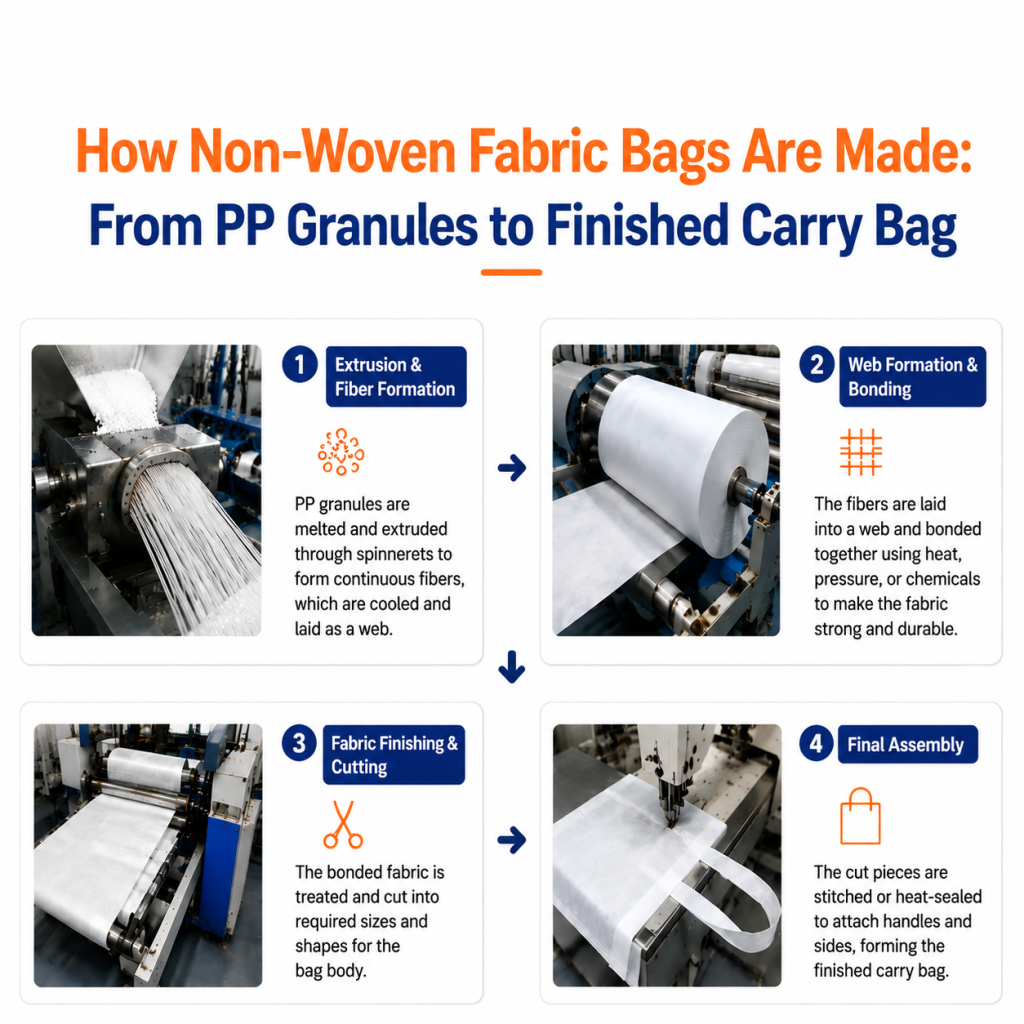
Now to the real question — How Non-Woven Bags Are Made on the Factory Floor. The journey from raw plastic granules to a finished carry bag involves five clear stages. Let’s break each one down.
Step 1: Raw Material Preparation
Everything begins with virgin PP granules — small, translucent pellets of polypropylene. Reputable manufacturers test each batch for melt-flow index, colour, and purity. Master-batch colour pigments are then added at this stage to achieve the brand-required shade, whether deep indigo, vibrant orange, or soft white. Once mixed, the granules move into a hopper, ready for melting.
Step 2: Spunbond Extrusion (PP Non-Woven Fabric Production)
This stage is the heart of PP non-woven fabric production. First, the granules heat to roughly 230–250°C until they form a smooth, flowing polymer melt. Next, the molten plastic is forced through fine spinnerets — metal plates with thousands of tiny holes — producing continuous filaments.
These filaments cool instantly in a quench chamber, and air streams stretch them to align the fibres. Subsequently, they fall onto a moving conveyor belt to form a fluffy web. So far, the web stays loose and easily pulled apart.
To turn it into proper fabric, the web passes between two heated calendar rollers. The pressure and heat bond the fibres at thousands of microscopic points, creating a uniform sheet. The result is PP non-woven fabric in GSM ranges from 8 to 300, suitable for everything from delicate hygiene products to heavy-duty shopping bags.
Step 3: Slitting and Roll Formation
The freshly bonded fabric is wound onto large master rolls. After that, these rolls are slit into narrower widths according to bag size requirements. For example, a 16-inch shopping bag needs a different roll width than a 10-inch pharmacy bag.
Quality control teams check GSM consistency, tensile strength, and colour accuracy at this stage. Importantly, rolls that fail tests are reprocessed rather than passed forward — a key marker of a serious manufacturer.
Step 4: Printing the Brand Design
Most clients want their logo, address, or marketing message printed on the bag. Printing happens before bag-making and uses three common methods:
- Flexographic printing for simple, high-volume designs in 1–4 colours.
- Screen printing for vivid, large-area artwork with thicker ink coverage.
- Offset printing for photographic, multi-colour, premium finishes.
Inks used are eco-solvent or water-based, so finished bags remain safe for food and retail contact.
Step 5: Non-Woven Fabric Bag Manufacturing Process — Cutting and Stitching
The final stage is the non-woven fabric bag manufacturing process itself. Printed rolls feed into automatic D-cut, U-cut, W-cut, or box-bag machines depending on the design. These machines:
- Unroll the fabric.
- Cut the bag shape and handle holes.
- Heat-seal or ultrasonic-weld the side seams.
- Stack and count finished pieces.
Modern non-woven carry bag manufacturing lines produce up to 80–120 bags per minute. Afterwards, the bags are packed in bundles of 50 or 100 and dispatched to clients across India and overseas.
Why Non-Woven Fabric Bags Are Winning the Indian Market in 2026
The shift away from single-use plastic has rewritten the rules for Indian packaging, and non-woven fabric bags have quietly emerged as the clear commercial winner. From small kirana shops in Hyderabad to large supermarket chains across the country, the same story plays out — brands that switched early are now seeing higher repeat footfall, stronger customer recall, and zero compliance headaches under state-level plastic-ban rules.
The market story is striking. India’s non-woven sector has grown into one of the fastest-moving segments in packaging, with bag-making capturing the largest share of that output. Demand has climbed sharply year on year since the central plastic ban tightened, driven by retail expansion, e-commerce shipping needs, and an export market that increasingly favours plastic-free packaging. PP non-woven fabric sits at the heart of this growth because it strikes a balance no other material has matched — tough enough for daily reuse, light enough to ship in bulk, and printable enough to double as a moving marketing asset.
Who Should Choose Non-Woven Fabric Bags?
These bags suit a wide range of buyers. You should consider non-woven fabric bags if you run any of the following:
- Retail stores and supermarkets that need reusable shopping bags after the plastic ban.
- Pharmacies and clinics that want branded, hygienic carriers for medicines.
- Garment showrooms and boutiques seeking a premium unboxing experience.
- Sweet shops, bakeries, and restaurants requiring food-grade carry bags.
- Event planners and corporates distributing welcome kits or conference giveaways.
- Exporters packing finished goods for Africa, Southeast Asia, or the Middle East.
Bulk buyers benefit the most because the per-piece price drops sharply at higher quantities.
Are Non-Woven Bags Safe? Risks to Watch For
When sourced from a certified manufacturer, non-woven carry bags are safe for everyday and food-contact use. However, buyers should stay alert to a few risks:
- Sub-standard recycled material: Cheap suppliers sometimes mix waste plastic, which weakens the bag and may release odour.
- Overstated GSM claims: Always weigh a sample. A genuine 80 GSM bag should not feel paper-thin.
- Heat exposure: Like any PP product, the fabric softens above 130°C, so avoid hot-fill contents.
- Poor stitching: Weak ultrasonic welds split under load. Therefore, inspect side seams carefully before bulk acceptance.
Choosing an ISO 9001:2015 and CE-certified manufacturer such as Savitridevi Polyfabrics significantly reduces these risks.
Conclusion:
The journey from PP granules to a finished carry bag is a precise, well-engineered process — and the quality of your final bag depends entirely on the manufacturer behind it. With over a decade of experience, 15,500 TPA capacity across five production lines, and certifications including ISO 9001:2015, CE, GMP, and Make in India, Savitridevi Polyfabrics produces non-woven fabric bags trusted by retailers, exporters, and brands across India and beyond.
Whether you need 5,000 plain bags or one million custom-printed totes, our team in Hyderabad and Nagpur is ready to help.
📞 Call: +91 99634 70257 / +91 99634 70259 📧 Email: info@savitripolyfab.com 🌐 Visit: savitripolyfab.com
👉 Request a sample today and see the difference quality non-woven carry bag manufacturing makes.
Frequently Asked Questions
1. How long do non-woven fabric bags last?
With normal use, a good-quality bag lasts 50 to 100 reuses, which is dramatically better than single-use plastic.
2. Are non-woven carry bags biodegradable?
They are not fully biodegradable, but they are 100% recyclable and can be reprocessed into new PP products.
3. What is the minimum order quantity for custom printed bags?
Most Indian manufacturers accept MOQs of 5,000–10,000 pieces for custom prints. Plain stock bags are available in smaller quantities.
4. Can non-woven fabric bags be used for food packaging?
Yes — provided the manufacturer uses food-grade PP and food-safe inks, and the bag carries proper certification.
5. How does PP non-woven fabric compare to woven PP?
Non-woven is softer, faster to produce, and cheaper for short-life carry bags. Woven PP is stronger and better suited for heavy-duty sacks like cement or grain bags.
6. What GSM is best for shopping bags?
For everyday retail, 70–90 GSM strikes the right balance of strength and cost. Premium boutiques often choose 100–120 GSM.