
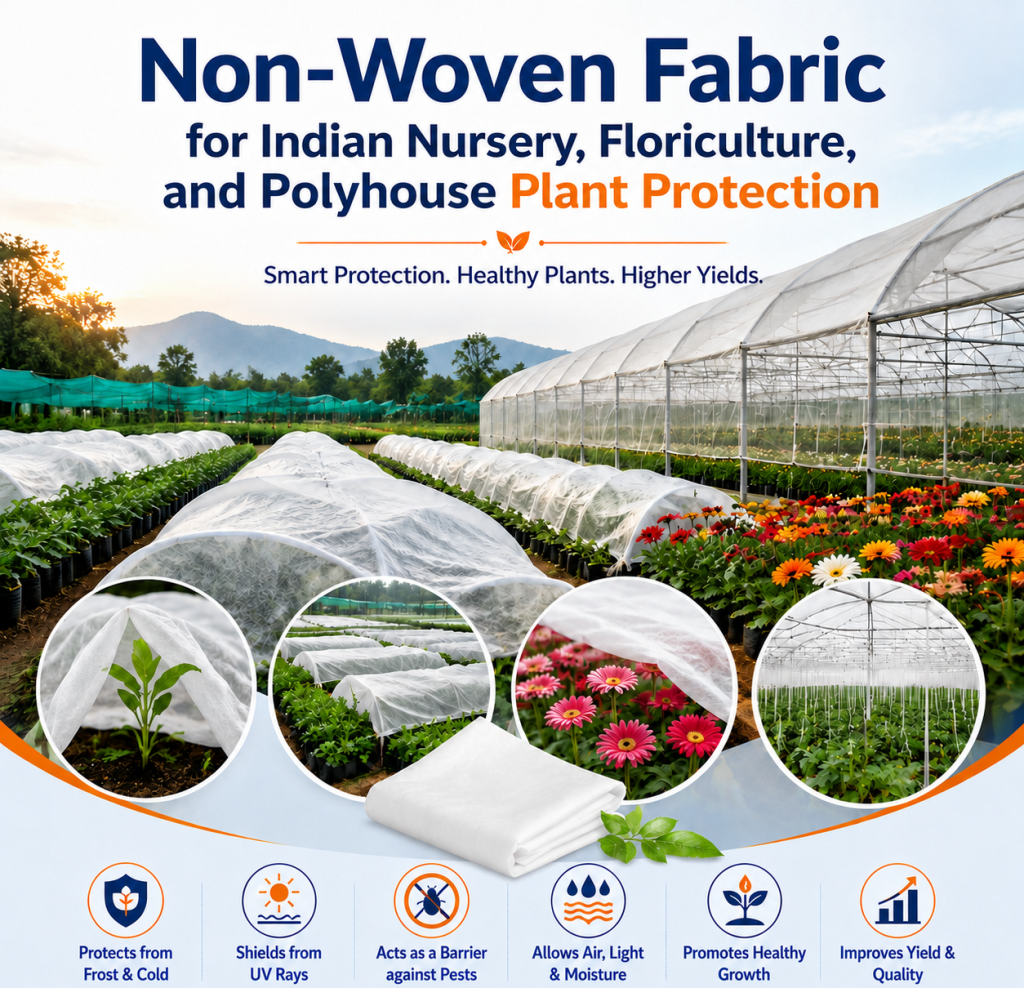
Non woven fabric has quietly become the backbone of plant care across Indian nurseries, flower farms, and polyhouses. From shielding tender saplings against early frost to wrapping rose buds before transit, this lightweight cloth handles work that growers once managed by hand. Moreover, it serves without crushing leaves, soaking up rain, or blocking sunlight.
As Indian horticulture moves toward higher yields and cleaner produce, farmers from Pune to Pollachi are switching to spunbond polypropylene. They use it as their preferred plant protection fabric. In this guide, we break down where it fits, why it works, and how to pick the right grade for your specific crop.
Furthermore, we cover its role in floriculture, polyhouse cultivation, and seasonal cover applications. By the end, you will know exactly how to choose, deploy, and reuse this versatile material across your operations.
Why Non Woven Fabric Matters for Indian Nurseries
Indian nurseries face a tough mix of challenges. Scorching summer heat hits in May. Sudden hailstorms strike in March. Pest pressure stays high almost all year. Therefore, plastic sheets and shade nets often fall short. Non woven fabric, by contrast, breathes like cotton yet repels water like a raincoat.
For effective nursery plants care, this difference matters in three clear ways. First, the cloth lets air and moisture move freely, so seedlings avoid fungal rot. Second, it keeps soil temperature steady, which boosts germination rates. Third, it blocks aphids, whiteflies, and other tiny invaders without any chemical spray.
Furthermore, the material is reusable across multiple seasons. A typical 17 GSM cover lasts two to three crop cycles with careful handling. Indian nursery owners particularly value such longevity. Labour and input costs keep climbing every year, so every reusable item counts.
Notably, this fabric is also extremely light. Workers can roll it out across long beds in minutes. They then peel it back at harvest without disturbing root systems. As a result, transplant shock drops sharply. Survival rates often jump by 15 to 20 percent in well-managed nurseries.
Floriculture Applications of Non Woven Fabric Plant Protection
Indian floriculture is booming, with rose, gerbera, chrysanthemum, and marigold farms expanding from Bangalore to Pune. However, flowers are delicate and fussy. Therefore, growers need barriers that protect blooms without harsh side effects. Non woven fabric plant protection ticks every box for this segment.
In rose cultivation, for example, lightweight 12 GSM covers shield buds from morning dew. Excess dew triggers Botrytis, the dreaded grey mould of cut flowers. Similarly, gerbera farmers use 20 GSM sheets as ground covers to suppress weeds while letting irrigation water seep through.
Marigold growers take a slightly different angle. They wrap entire beds in 25 GSM covers during the late monsoon. This step keeps petals dry and golden right up to peak Diwali demand. Likewise, chrysanthemum producers prefer white-coloured fabric to reflect heat, which extends shelf life on the plant.
Importantly, the cloth also doubles as a packaging layer. Florists in Hyderabad and Mumbai wrap bouquets in soft white spunbond before transport. The material cushions petals, soaks excess moisture, and keeps the arrangement looking fresh until delivery. Indian florists particularly appreciate that the covers are tear-resistant, food-grade, and fully recyclable.
Polyhouse Use of Agricultural Non Woven Fabric in India
Polyhouse farming is fast becoming the future of high-value horticulture in India. From capsicum in Maharashtra to strawberries in Himachal, climate-controlled structures are pushing yields past anything open fields can offer. Inside these polyhouses, agricultural non woven fabric India suppliers like Blue Horse play a quiet but crucial role.
First, growers wrap the cloth around plants as a thermal blanket on cold winter nights. It traps daytime heat near the soil, which protects shallow roots from frost shock. Second, it acts as an internal shading layer during peak summer. Operators simply pull it across the polyhouse roof to cut harsh midday glare.
Moreover, polyhouse owners apply the fabric as a mulch layer at the base of plants. This dramatically reduces water evaporation. As a result, irrigation cycles can drop by 25 to 30 percent. Drip lines also stay cleaner because soil splash on leaves becomes minimal.
Additionally, the material works well as a partition curtain inside large polyhouses. Different crops need different humidity levels, and a simple non woven fabric curtain creates micro-zones cheaply. Hence, Indian polyhouse owners are increasingly stocking rolls of 35 to 50 GSM cloth as a standard input alongside drip pipes and trellis wires.
Crop Cover Non Woven Fabric for Seasonal Care
Across north Indian wheat belts and southern paddy zones, crop cover non woven fabric is becoming a seasonal essential. In winter, light frost can wipe out an entire vegetable plot overnight. In summer, harsh sun can scorch leafy greens within hours. A simple cover handles both extremes.
For winter use, growers spread 20 GSM white sheets across cabbage, cauliflower, and tomato beds. The cloth raises bed temperature by 2 to 4 degrees Celsius. That swing is often the difference between survival and total loss. In addition, the cover speeds up early-season growth, so produce reaches the market two weeks ahead of open-field crops.
In summer, by contrast, growers roll dark-coloured covers across spinach, fenugreek, and amaranth plots. This application cuts evapotranspiration sharply and keeps leaves crisp. Consequently, harvest yields rise by up to 18 percent on trial farms across Telangana and Karnataka.
Beyond climate control, crop cover non woven fabric also protects against birds and insects. Sparrow flocks no longer wreck millet plots, and cabbage white butterflies lose their landing pad. Indian growers therefore see fewer pesticide rounds, lower spray bills, and cleaner produce at harvest time. Margins improve naturally as a result. For more on outdoor field use, read our detailed non woven crop cover guide.
How to Choose the Right Plant Protection Fabric
Selecting the correct plant protection fabric depends on three things: GSM, colour, and width. GSM, or grams per square metre, controls how much heat, light, and moisture pass through. Lower GSM is breathable and great for delicate seedlings. Higher GSM is sturdier and ideal for windy, exposed plots.
For most Indian nurseries, a 17 to 25 GSM cover hits the sweet spot. Meanwhile, for rugged outdoor crop covers, 30 to 50 GSM proves more reliable. In contrast, for industrial polyhouses, growers may prefer 60 GSM or even heavier grades that last several seasons.
Colour also matters more than people assume. White covers reflect sunlight, which keeps soil cool during peak summer. Black covers absorb light, which warms soil quickly during cold months. Green or silver shades suit specific ornamental crops where light filtering plays a key role. Research from the Indian Council of Agricultural Research backs many of these GSM-and-colour pairings for Indian agro-climatic zones.
Width is the third lever. Indian fields rarely come in standard sizes. Hence, custom widths from 1 inch to 128 inches are often essential. A reliable manufacturer like Blue Horse offers exactly this flexibility, so farmers can order rolls that fit their bed layouts perfectly. Ultimately, the right non woven fabric pays for itself within one or two crop cycles.
Why Indian Growers Trust Blue Horse Non Woven Fabric
Blue Horse, the flagship brand of Savitridevi Polyfabrics, has served Indian horticulture for over a decade. Based in IDA Bollaram, Hyderabad, with a branch at Itwari Station Road, Nagpur, the company runs five production lines and a 12,000 square metre facility. As a result, large bulk orders move out within days rather than weeks.
The brand offers spunbond polypropylene from 8 GSM to 300 GSM. Widths range from 1 inch to 128 inches. This sweep covers seedling trays, polyhouse curtains, and full-field crop covers without compromise. Furthermore, every roll is ISO 9001:2015, CE, and GMP certified, which means consistent quality batch after batch.
Indian nurseries, floriculture estates, and polyhouse operators particularly value Blue Horse for three reasons. First, the cloth is food-grade and chemical-free. Second, custom sizing means almost zero wastage at the bed. Third, the team ships across India and exports to Africa, Vietnam, and Bangladesh on a regular schedule. Explore our complete agriculture non woven fabric range for a full view of grades and use cases.
In short, Blue Horse non woven fabric blends quality, scale, and pricing flexibility in a way few Indian competitors can match.
Final Thoughts: A Smart Input for Modern Indian Growers
Indian agriculture is shifting fast. Climate swings are getting sharper, labour is getting costlier, and consumers are demanding cleaner produce. Therefore, growers need smart, affordable inputs that deliver year after year. Non woven fabric checks every box for nursery plants care, floriculture, polyhouse farming, and open-field crop covers.
Whether you run a 200-tray rose nursery or a five-acre capsicum polyhouse, the right plant protection fabric will tighten yields, cut input costs, and protect your margins. Get in touch with Blue Horse today for samples, GSM advice, and a quotation tailored to your specific crop.
Frequently Asked Questions
1. Which GSM of non woven fabric is best for Indian nurseries and polyhouses?
For most Indian nurseries, a 17 to 25 GSM cover offers the right balance of breathability and protection. Polyhouses usually need 30 to 60 GSM grades, while heavy-duty open-field crop covers may go up to 80 GSM.
2. Is non woven fabric reusable across multiple crop cycles?
Yes. A quality 20 to 25 GSM cover comfortably handles two to three full crop cycles when stored dry between seasons. Heavier 50 GSM and above grades can serve four to five seasons
3. Can non woven fabric protect crops from frost, hail, and strong sun?
Absolutely. White covers reflect sunlight to keep beds cool during peak summer, while heavier dark covers trap heat during cold winter nights. Moreover, the fabric absorbs the impact of light hail without tearing.
4. How does non woven fabric compare to plastic mulch and shade nets?
Plastic mulch blocks light but seals soil, which limits airflow. Shade nets cut sunlight but offer no moisture or pest control. Non woven fabric, by contrast, breathes, drains, blocks pests, and reflects or traps heat depending on colour.
5. Where can I buy bulk agricultural non woven fabric in India?
Savitridevi Polyfabrics, under the Blue Horse® brand, supplies bulk non woven fabric across India from its 12,000 square metre facility in Hyderabad.