
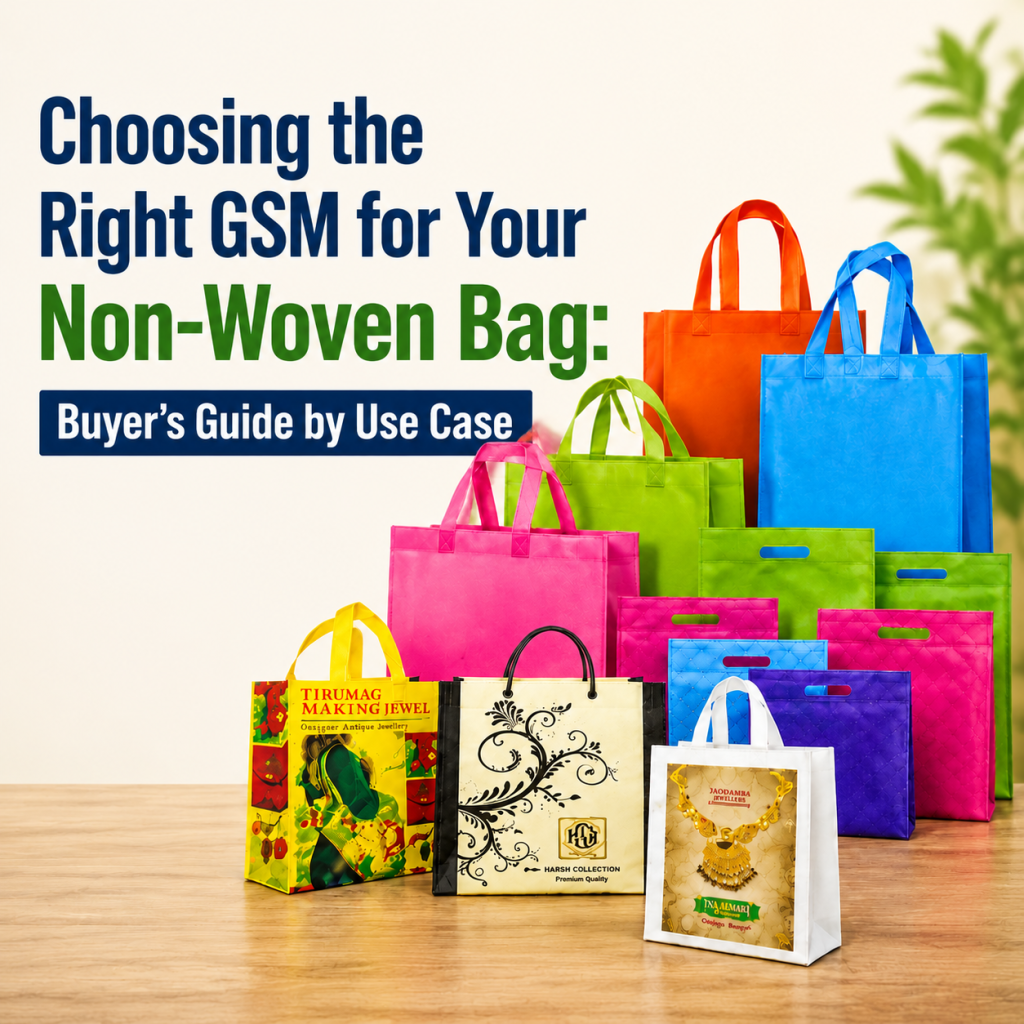
Choosing the right non-woven bag GSM is one of the most important decisions a buyer makes when ordering reusable carry bags in bulk. Get it wrong and you end up with bags that tear under load, look cheap at checkout, or quietly eat into your margins for no real benefit. Moreover, get it right and you walk away with carriers that protect your goods, lift your brand image, and survive hundreds of reuses. This complete guide walks you through every GSM band currently used in Indian non-woven manufacturing — and which one fits your specific use case in 2026.
What Is a Non-Woven Bag GSM?
GSM stands for “grams per square metre” and is the global standard for measuring fabric weight and density. In simple terms, the higher the non-woven bag GSM, the heavier, thicker, and stronger the bag will feel in the hand.
A 50 GSM fabric is light, almost translucent, and best suited to small-item packaging or single-use promotional carriers. A 200 GSM fabric, by contrast, feels closer to a sturdy canvas tote and easily holds 10 kilograms or more without distortion. Manufacturers in India typically produce non-woven fabric across the 8 to 300 GSM range, although the most popular bag-making weights sit between 50 and 120.
Therefore, knowing the right GSM for non-woven bags is the foundation of every smart procurement decision in this category.
Why the Right GSM Matters: Key Benefits
Picking the correct GSM is not just a technical detail — it directly shapes how customers experience your brand. A well-matched non-woven bag GSM gives you load safety, so the bag never splits under the weight it was designed to carry. It also delivers a premium hand-feel, which lifts perceived value at the till and increases the chance that the customer will reuse the bag many times over.
On top of that, the right thickness improves print quality because heavier fabric holds ink without bleeding or warping the printed surface. Equally important, choosing the correct GSM keeps your costs in check. A pharmacy that orders 120 GSM bags for paracetamol strips is overspending; a supermarket that orders 50 GSM bags for two-kilo loads is setting itself up for customer complaints. Striking the right balance is exactly what a proper non-woven fabric GSM guide is designed to help you do.
How Non-Woven Bag GSM Is Measured and Manufactured
Understanding how GSM is created on the factory floor helps buyers ask better questions of suppliers. The process begins with PP granules melted at around 240°C and forced through fine spinnerets to form continuous filaments. Those filaments fall onto a moving conveyor as a soft, fluffy web of fibre.
Next, the web passes between heated calendar rollers that bond the fibres into a uniform sheet. Importantly, the speed of the conveyor and the volume of polymer fed in together determine the final GSM. A slower conveyor with more polymer creates heavier fabric, while a faster line with less polymer gives lighter fabric.
Reputable manufacturers test every roll on a precision GSM scale and reject batches that drift more than 5 percent from the target weight. So when a buyer asks for 90 GSM, a serious factory delivers between 85 and 95 GSM consistently — never the cheaper “85 GSM sold as 90”.
How Non-Woven Bag GSM Affects Performance and Brand Impression
Beyond the technical numbers, non-woven bag GSM has a real effect on how a bag actually performs in customer hands and how it represents the brand carrying it. Buyers who treat GSM as just a manufacturing spec often miss the bigger picture — fabric weight directly influences durability, print quality, reuse rates, and even how customers feel about the brand at the till.
Durability is the most visible outcome. A 70 GSM bag stretches and softens after about thirty reuses, while a 100 GSM bag holds its shape and structure well past one hundred reuses. This matters most for retail brands that want their logo travelling through markets, metros, and offices for as long as possible. Higher GSM essentially means a longer-lived ad space carried by your customers wherever they go.
Print sharpness is another factor too often overlooked. Lighter fabric soaks ink unevenly, which can blur edges on fine logos and small text. Heavier fabric in the 90 to 120 GSM band locks ink cleanly into place, so brand colours stay vivid and details remain crisp wash after wash. For brands that invest in design, a thoughtful how to choose GSM for bags decision quietly protects that entire design investment.
Customer perception completes the picture. A flimsy bag tells the customer the product inside is also flimsy, while a well-built non-woven carrier signals quality, care, and intention. That single tactile moment at checkout shapes repeat purchases more than most brand managers realise — and it costs nothing extra to get right when GSM is chosen carefully from the very start.
Best Non-Woven Bag GSM by Use Case: 2026 Buyer’s Guide
Now to the practical part. Below is a use-case-by-use-case non-woven bag thickness guide based on what Indian retailers, exporters, and brands actually order in 2026.
50–60 GSM: Light Carry and Promotional Use
This range suits brochure handouts, conference giveaways, jewellery pouches, and single-product promotional bags. The fabric is light, prints sharply, and works well for short-term use. However, it is not strong enough for grocery loads or daily reuse.
70–80 GSM: Pharmacy, Boutique, and Mid-Retail
This is the workhorse band for chemists, garment showrooms, sweet shops, and bookstores. An 80 GSM bag comfortably carries 5 to 7 kilograms and survives 50 or more reuses. Most Indian retailers treat this range as their everyday standard.
90–100 GSM: Supermarkets and Heavy Retail
When customers walk out with milk, atta, and oil all in one bag, you need 90 to 100 GSM. The fabric handles 8 to 10 kilograms without distortion and shrugs off wet groceries. Supermarkets across Hyderabad, Chennai, and Mumbai now treat 90 GSM as their default specification.
110–150 GSM: Premium Retail, Gifting, and Exports
Luxury fashion, electronics packaging, and wedding gifting all sit comfortably in this band. The fabric feels substantial in the hand, accepts photographic-quality print, and signals brand quality the moment the customer touches it. Exporters also prefer this range for international shipping where the bag needs to survive long handling cycles.
180–300 GSM: Industrial and Specialised Applications
The heaviest grades of non-woven fabric serve agricultural ground covers, furniture lining, mattress backing, and industrial filtration rather than carry bags. If your supplier suggests 200+ GSM for a regular shopping bag, push back — it is almost certainly overkill for retail use.
Common Mistakes and Risks When Choosing Non-Woven Bag GSM
Even experienced buyers slip up on GSM selection. The most common mistake is over-ordering thickness because “thicker must mean better”. In reality, the wrong-fit GSM raises cost without adding any real value — a 120 GSM pharmacy bag is wasted material when 70 GSM would do the same job at far lower cost.
The second risk is supplier mislabelling. Some low-cost factories sell 75 GSM stock as 80 GSM, or quietly use recycled polymer to hit a price point. Therefore, always weigh a sample with a digital scale before approving a bulk order, and ask for a third-party test certificate when GSM accuracy genuinely matters.
Finally, watch for GSM mismatched with handle type. A heavy 100 GSM bag fitted with a thin D-cut handle will stress the cut-out under load and tear at the handle first. Match handle strength to fabric weight, and your bags will outlast the product cycles they carry.
Conclusion:
Choosing the right non-woven bag GSM does not have to be complicated. Match the thickness to your real-world load, brand positioning, and order volume, and the rest follows naturally. With more than a decade of experience and the ability to produce non-woven fabric across the full 8–300 GSM range, Savitridevi Polyfabrics(Blue Horse®) helps Indian retailers, pharmacies, supermarkets, and exporters land on the perfect GSM the first time.
📞 Call: +91 99634 70257 / +91 99634 70259 📧 Email: info@savitripolyfab.com 🌐 Visit: savitripolyfab.com
👉 Request a sample pack in your target GSM and feel the difference quality fabric makes.
Frequently Asked Questions
1. What is the most popular non-woven bag GSM in India?
The 70–90 GSM range is the most widely used because it balances strength, print quality, and cost effectively for everyday retail.
2. Can a higher GSM make my brand look more premium?
Yes. Bags in the 100–120 GSM band feel substantial at touch and create a clear premium impression — ideal for boutique fashion and corporate gifting.
3. How do I verify the GSM claimed by a supplier?
Cut a 10 cm × 10 cm square from a sample, weigh it on a digital scale, and multiply the weight by 100. The result is the actual GSM of the fabric.
4. Does a higher GSM affect printing quality?
Yes. Heavier fabric holds ink more cleanly and produces sharper edges, which is why it is preferred for full-colour, photographic, and multi-pass print designs.
5. Is 50 GSM safe for grocery shopping?
No. 50 GSM is too light for daily grocery loads. Use 80 GSM or higher for any bag expected to carry over 3 kilograms regularly.
6. What GSM do exporters typically order?
Most exporters serving Africa, Southeast Asia, and the Middle East prefer 90–120 GSM bags, which survive long-haul shipping and repeated handling without tearing.


En esta plataforma, los usuarios podrán acceder a dinero en línea.
El servicio presenta alternativas de financiamiento a la medida las cuales responden a las urgencias del solicitante.
MobCash
El proceso suele ser fácil y se lleva a cabo de manera íntegramente virtual, sin necesidad de trámites complicados.
Asimismo, la plataforma pretende proporcionar una experiencia ágil así como seguro a sus usuarios.